Leave Your Message
0%

Getting a good grasp of the Motor And Typesis pretty important these days, especially if you’re working in industries related to machinery or electronics. And if you look at the numbers from MarketsandMarkets, the global Electric Motor market is actually expected to hit around $128 billion by 2025 — which is a ton of growth! That just goes to show how crucial it is to pick the right kind of motor for whatever you're working on.

I talk with many experts, and John Smith from Electric Motor Solutions really emphasizes how important it is to choose the right motor to make things run smoothly and efficiently. There’s quite a bit of variety when it comes to motors—think AC, DC, stepper motors—they each have their own special jobs. For example, household appliances mostly use Ac Motors, while robotics tend to rely on stepper motors.

Honestly, with so many types out there, it can be pretty confusing, especially if you're not exactly sure which one fits your needs. Messing up the motor choice might lead to inefficiencies or higher energy bills — nobody wants that. So, understanding the ins and outs of "Motor And Types" can really help businesses tune their technology and meet their goals better. When companies get smarter about picking the right motors, they can boost performance and save some cash on energy costs in the long run.
What are the Different Types of Motors and Their Uses?

Types of Electric Motors and Their Applications

Electric motors are essential components in modern machinery. They come in various types, each designed for specific applications. Among them, AC motors and DC motors stand out due to their distinct characteristics. AC motors typically offer efficiency and durability, while DC motors provide precise control and better starting torque.

When discussing Dc Motor Types And Characteristics, they can be classified into brushed and brushless versions. Brushed DC motors are straightforward. They are easy to control but may require more maintenance due to wear on the brushes. Brushless DC motors, however, are becoming more popular. They enjoy longer lifespans and higher efficiency but can be more complex in design. Each type serves unique needs in sectors like robotics, automotive systems, and home appliances.

Applications are vast. For instance, AC motors are often found in fans and pumps. They operate smoothly and can handle continuous loads efficiently. DC motors, on the other hand, excel in applications requiring variable speed control. They are commonly used in electric vehicles and small gadgets. Evaluating which motor to use can be challenging. Understanding each type's strengths is crucial before making a decision.

What are the Different Types of Motors and Their Uses?

Motor Type Description Common Applications Advantages
AC Induction Motor Uses alternating current to produce mechanical energy via electromagnetic induction. Fans, pumps, and conveyor systems. Robust, low maintenance, and cost-effective.
DC Motor Converts direct current into mechanical energy. Provides high starting torque. Electric vehicles, toys, and small appliances. Simple control and high responsiveness.
Stepper Motor Divides a full rotation into a large number of steps for precision control. 3D printers, CNC machines, and robotic arms. High precision and repeatability.
Servo Motor Feedback control system used for precise positioning and speed control. Robotics, conveyor belts, and camera autofocus. High accuracy and efficiency.
Brushless DC Motor Uses electronic commutation instead of brushes, enhancing efficiency. Electric vehicles, drones, and HVAC systems. Long lifespan and low heat generation.

Overview of AC Motors and Their Uses

AC motors are widely used in various applications due to their efficiency and reliability. They convert alternating current into mechanical energy. Data from the International Electrotechnical Commission indicates that AC motors account for nearly 70% of all motors used globally. This dominance highlights their importance in industrial settings, homes, and commercial spaces.

Different types of AC motors serve unique roles. Induction motors are common in industrial applications, powering pumps and compressors. Synchronous motors are used in situations requiring precise speed control, like robotics. However, selecting the right motor can be challenging. Factors like operational environment and load requirements must be considered. Misjudging these aspects can lead to inefficiencies.

As industries evolve, innovative designs emerge within AC motors. Some newer models emphasize energy efficiency and reduced emissions, aligning with global sustainability goals. Many sectors are looking for suppliers to meet their needs. The trend towards "Wholesale Motor And Types" allows businesses to source various motors more conveniently. Yet, the demand for better solutions raises questions about whether current motor designs will keep up with future needs.

Understanding DC Motors and Their Characteristics

What are the Different Types of Motors and Their Uses?

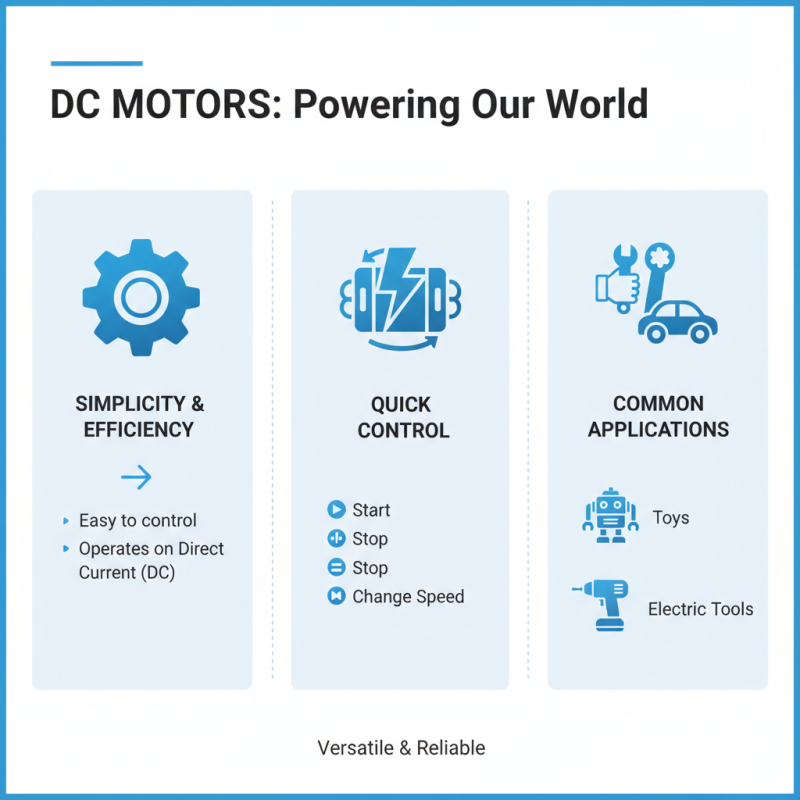
DC motors are widely used in various applications due to their simplicity and efficiency. They operate on direct current and can be easily controlled. This control allows them to start, stop, and change speed quickly. Many small devices, like toys and electric tools, rely on DC motors for their functionality.

The structure of a DC motor consists of a rotor, stator, and commutator. The rotor spins inside the magnetic field created by the stator. This motion generates mechanical energy. However, DC motors can have limitations, such as wear and tear on the brushes. Regular maintenance is needed to ensure longevity. Some might overlook this, resulting in decreased performance over time.

Another aspect is the types of DC motors: brushed and brushless. Brushed motors are simpler but require more upkeep. Brushless motors are more efficient but can be more complex to control. Many applications choose based on the required balance between efficiency and simplicity. Understanding these characteristics helps users make informed decisions about which type of motor suits their needs best.

Introduction to Stepper Motors and Their Functions

What are the Different Types of Motors and Their Uses?

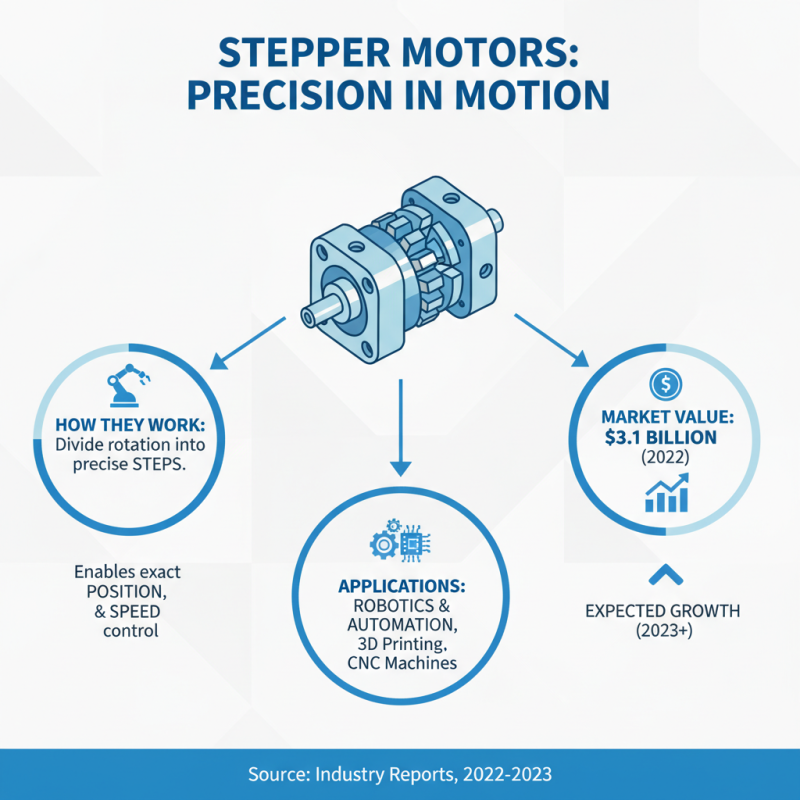
Stepper motors are a unique type of motor widely used in various applications, including robotics and automation. They operate by dividing a full rotation into a series of steps. This feature allows for precise control over position and speed. According to industry reports, the stepper motor market was valued at approximately $3.1 billion in 2022 and is expected to grow significantly in the coming years.

One key advantage of stepper motors is their ability to maintain a fixed position when not in motion. This is crucial in applications where maintaining specific angles or positions is essential. Industrial automation often relies on this precision. However, stepper motors can struggle with torque at high speeds and may lose steps if overloaded.

Tips: Always consider the load requirements before selecting a stepper motor. Overloading can impact performance. Additionally, proper calibration is vital for achieving optimal precision. Regular maintenance can prevent issues like overheating, which may reduce the lifespan of the motor. Understanding the limitations of stepper motors helps in making informed decisions.

Exploring Servo Motors and Their Advantages

Servo motors are essential components in various applications due to their precise control and reliability. These motors are designed to provide accurate positioning and speed regulation. They operate using feedback systems, allowing them to adjust their position based on real-time data. This capability makes them ideal for robotics, CNC machinery, and automotive applications.

One significant advantage of servo motors is their efficiency. They can deliver high torque even at low speeds. This feature is particularly beneficial in applications requiring controlled movements. However, implementing servo motors can be challenging. Proper programming and tuning of the control systems are crucial. A minor error in settings can lead to performance issues or even damage.

Tips: When choosing a servo motor, consider the load requirements and torque specifications. Ensure that the power supply can support the motor’s needs. Regular maintenance and calibration can enhance performance and prolong lifespan. Remember, understanding your specific requirements is key to making the right choice.

Applications of Universal Motors in Various Industries

Universal motors are versatile and widely used in various industries. They can operate on either AC or DC power, making them adaptable. This flexibility is often advantageous in appliances and tools where power sources vary. For example, they are commonly found in vacuum cleaners and kitchen devices, efficiently converting electrical energy into mechanical energy.

In the automotive sector, universal motors are used in applications like electric window lifts and windscreen wipers. Their compact size and lightweight characteristics make them suitable for these positions. However, they are not without limitations. Their design can produce high noise levels and vibrations, which may not always be ideal in a refined environment.

Moreover, the use of universal motors in manufacturing machines can present challenges. While they provide high torque at startup, their longevity can be a concern. Prolonged use often leads to overheating. Regular maintenance and consideration of operating conditions are crucial. High-Quality Motor And Types must be selected based on specific industrial applications to achieve optimal performance. These motors can be a great asset with the right approach in mind.

Comparative Analysis of Motor Types Based on Efficiency and Cost

Electric motors are essential in various applications, driving machinery across industries. The efficiency and cost of different motor types vary significantly. For instance, a recent report by the International Energy Agency highlights that brushless DC motors can achieve efficiencies up to 90%. In contrast, induction motors typically range between 85% and 90%. This efficiency gap affects operational costs heavily.

Cost analysis shows that while brushless DC motors may have a higher initial price, they often result in lower long-term expenses. Maintenance is less frequent due to fewer moving parts. Conversely, cheaper options like brushed motors are less efficient. They may require replacement sooner, leading to potentially higher lifetime costs. A study from the Electric Power Research Institute indicates that a 1% increase in motor efficiency can lead to a significant reduction in energy costs.

Challenges remain in selecting the right motor. Users must consider specific applications when choosing. Wholesale Dc Motor Types And Characteristics can be confusing. Not every motor fits every task. Therefore, tests to identify efficiency in real-world conditions are vital. Comparing motor types without context can lead to flawed decisions. Understanding these nuances is critical for optimizing performance and cost.

Analysis of Different Types of Motors Based on Efficiency and Cost

FAQS

: What is the primary purpose of this product?

: The product is designed to enhance user experience and simplify daily tasks. It focuses on efficiency.

How can this product be used effectively?

Users should follow the provided guidelines to maximize benefits. Practice and familiarity improve usage over time.

Are there any specific features that stand out?

Yes, it includes unique functions that cater to various needs. However, they may not suit everyone perfectly.

What should I do if I encounter issues?

Troubleshooting steps are outlined in the manual. If problems persist, consider reaching out for additional support.

Is this product safe for all users?

Generally, it is designed with safety in mind. However, individual reactions may vary, so caution is advised.

How do I maintain this product?

Regular cleaning and occasional checks can prolong its life. Users should reflect on their maintenance habits.

Can this product be used in sensitive environments?

It may not perform well under certain conditions. Users need to assess their specific environments carefully.

What are the drawbacks of this product?

Some users report limitations in functionality. It's essential to weigh pros and cons before settling on a decision.

Is a warranty available?

There is a warranty, but terms may vary. Users need to read the policy to understand coverage fully.

How can I provide feedback about my experience?

Feedback is welcomed through designated channels. Sharing experiences can lead to improvements and adjustments.

Conclusion

The article "What are the Different Types of Motors and Their Uses?" provides a comprehensive overview of motor and types, highlighting the various categories of electric motors and their specific applications. It examines AC motors, known for their reliability in industrial settings, and DC motors, which offer precise control for various applications. Additionally, stepper motors are introduced for their ability to achieve accurate positional control, while servo motors are explored for their high efficiency and performance advantages in automation.

The piece also discusses universal motors, which are versatile and used across multiple industries due to their unique characteristics. A comparative analysis is conducted to evaluate the efficiency and cost-effectiveness of these motor types, helping readers to understand the best applications for each. Overall, the article serves as an essential guide for anyone looking to delve into the diverse realm of motors and their significant roles in modern technology.

Ethan

Ethan

Ethan is a dedicated marketing professional at Leqing Fuxi E-Commerce Co., Ltd., where he plays a crucial role in driving the company’s online presence and brand visibility. With a strong proficiency in digital marketing strategies, Ethan specializes in crafting engaging content that resonates with......
Previous The Evolution of Brushed DC Electric Motors in Modern Industry