In today's fast-changing world of automation, picking the right components can make all the difference. Lisa Tran, an engineer at RoboTech Solutions, points out, “The right Robot Motorsreally can boost efficiency quite a bit.” As industries continue to push for better performance, choosing dependable Robot Motors is pretty much essential for successful automation efforts.
The landscape of automation today calls for precision and durability. These Robot Motors are like the backbone of many operations — from assembly lines to robotic arms. But here’s the thing: not every motor is built the same. Companies need to carefully consider factors like torque, speed, and whether the motor fits with their existing setup. Unfortunately, many businesses get caught up in the details and sometimes overlook key specs that really matter.
Investing in good-quality Robot Motors isn’t just a trend anymore — it’s pretty much a necessity. Making the wrong choice could mean inefficiencies or, worse, higher costs down the line. So, take some time to really think about what you need and the tech that's out there. Understanding your automation goals will help you pick the best Robot Motors for your projects and avoid headaches later on.

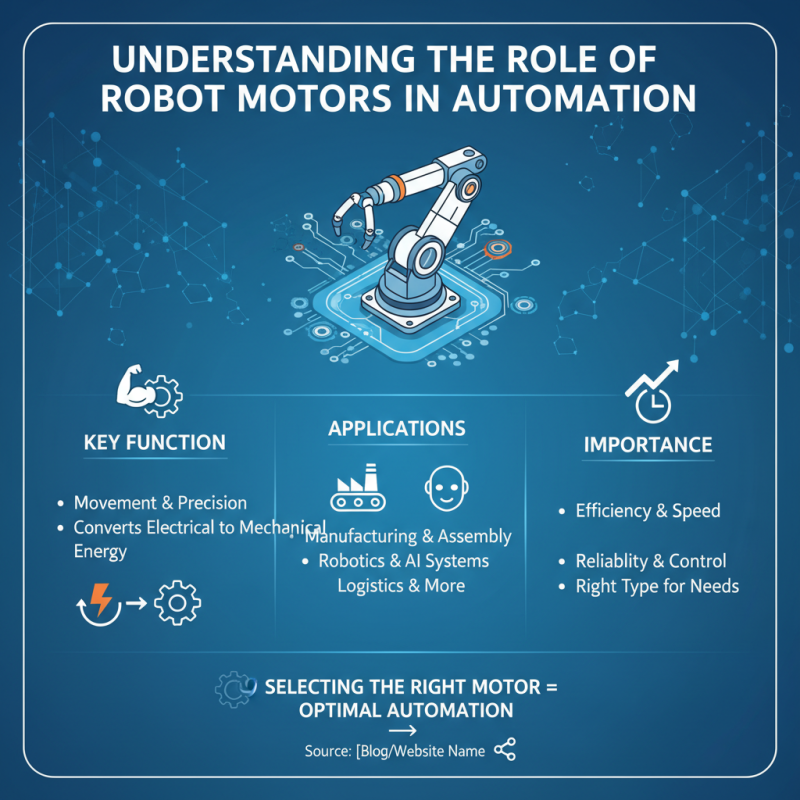
Understanding the Role of Robot Motors in Automation
Robot motors play a crucial role in automation. They provide the movement and precision needed in various applications. Whether in manufacturing or robotics, their efficiency is key. These motors convert electrical energy into mechanical energy, driving gears and wheels. Understanding their operation aids in selecting the right type for your needs.
When choosing robot motors, consider the application. Think about speed and torque requirements. Not all motors are equal. Some excel in speed but lack torque. Others provide great torque but are slower. It's essential to analyze your project's specific needs. Testing different motors can lead to insights. You may find unexpected results that change your approach.
Tip: Start with prototyping. This helps identify the right Motor Type for your application. Don't hesitate to experiment with different configurations. Sometimes, a simple change can improve performance.
Another point to ponder is the power supply. Some motors require specific voltage levels. Overloading can lead to malfunctions. Be mindful of power ratings. It’s crucial to match motors with compatible systems. Ensure that the control interfaces align with the selected motor.Sometimes, miscalculating these aspects could lead to wasted resources and time.
Types of Robot Motors and Their Applications
When it comes to automation, robot motors play a crucial role. Different Types Of Motors serve various functions.Electric motors are commonly used in many applications. They provide precise control and are efficient in energy use. These motors can be found in robotic arms and conveyor systems. They excel in tasks requiring accuracy.
Servo motors are another key type. They offer high torque and positional precision. This makes them ideal for applications like CNC machines and automated assembly. The control system in a servo motor ensures it moves exactly as needed. However, they can be more complex to integrate into systems. This complexity may require additional time for development.
For less demanding tasks, stepper motors can be a good choice. They are easy to use and provide good reliability. Their simplicity can sometimes feel limiting, though. Certain tasks may need more advanced motors. In many cases, purchasing Wholesale Robot Motors can be beneficial. It allows for flexibility in choosing the right type for specific needs. Ultimately, evaluating the requirements is key to selecting the right motor.
Advantages of Using Robot Motors for Automation Tasks
Robot motors are becoming essential for automation tasks across various industries. Their precise control and high efficiency contribute to streamlined processes. According to a recent report by MarketsandMarkets, the global industrial robotics market is projected to grow to $73 billion by 2026. This growth highlights the increasing dependence on robotics for manufacturing and logistics.
One major advantage of using robot motors is their ability to operate continuously. Unlike human workers, robots do not require breaks. They can work around the clock, increasing productivity. This uninterrupted operation can lead to a significant reduction in labor costs. However, it also raises concerns about job displacement, which is a challenge for industries. The balance between automation benefits and workforce impacts needs careful consideration.
Moreover, robot motors can handle tasks that require high precision. For example, in assembly lines, these motors can place components with an accuracy of up to ±0.01 mm. Such precision minimizes errors and waste. Still, integrating robot motors can be complex. There is a learning curve for staff and potential technical glitches. Companies must weigh these factors against the benefits to find the right fit for their automation needs.
Why Choose Robot Motors for Your Automation Needs?
| Feature | Advantage | Application Area |
| High Torque | Enables precise movements and lifting heavy loads. | Industrial Robots, Assembly Lines |
| Compact Design | Saves space in machinery and setup. | Automated Workstations |
| Energy Efficiency | Reduces energy costs and environmental impact. | Smart Manufacturing |
| Robust Control Algorithms | Provides reliable and accurate control of movement. | Drones, Autonomous Vehicles |
| Versatility | Can be used in a variety of applications and industries. | Agricultural Robotics, Service Robots |
Factors to Consider When Selecting Robot Motors
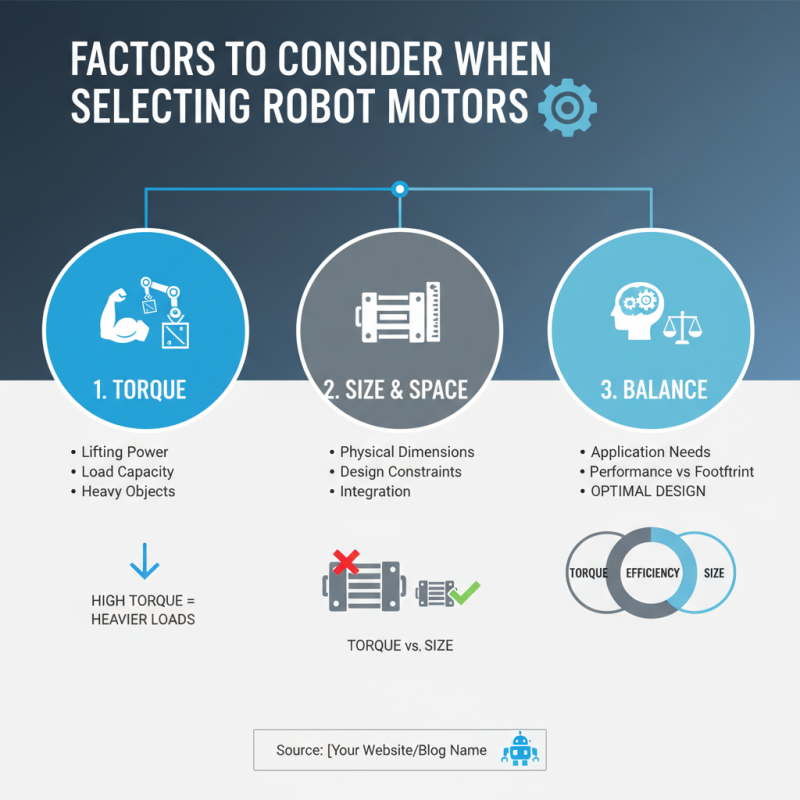
When selecting robot motors for automation, various factors come into play. One critical aspect is torque. Torque determines how much load a motor can handle. High torque is essential for applications that require moving heavier objects. However, more torque often means larger motor sizes. This could lead to spatial constraints in your design. Understanding the balance between torque and size is vital.
Another factor to consider is the motor's speed and precision. Motors must respond quickly and accurately to commands in many tasks. A high-quality robot motor provides both speed and precision. There are motors that excel in one area but falter in another. Picking the right motor for specific applications can be tricky. It requires a deep dive into your current and future demands.
Power consumption cannot be overlooked. Motors running continuously consume energy. An energy-efficient motor can reduce operational costs significantly. However, High-Quality Robot Motors may be more expensive upfront. This raises the question: Is the long-term savings worth the initial investment? Evaluating costs with performance will guide you in the right direction.
Comparing Robot Motors with Traditional Actuation Methods
When comparing robot motors with traditional actuation methods, it's clear that the landscape is changing. Traditional motors often rely on mechanical linkages and gears. This can create friction and result in inefficiencies. In contrast, Zhengke Robot Motors utilize more fluid and precise movements. They reduce mechanical wear and tear over time, leading to longer lifespans.
Precision is another significant factor. Robot motors can control speed and torque with exceptional accuracy. This makes them ideal for tasks that require repetitive actions, like assembly lines. However, integrating these systems can be challenging. Engineers must consider the entire automation ecosystem. Adjusting legacy systems to work with new motors isn’t always straightforward.
Cost is also a crucial aspect. Traditional actuation methods often have lower initial costs. But ongoing maintenance can be expensive. Robot motors might be pricier upfront, but their reduced need for repairs could balance the scales. This is an area where many businesses have to reflect on their long-term strategies. In the world of automation, the transition to technologies like Zhengke Robot Motors is not just an option; it's becoming a necessity.
Comparison of Robot Motors and Traditional Actuation Methods
This chart compares key performance metrics between robot motors and traditional actuation methods. Robot motors generally offer higher speed and efficiency, making them more suitable for modern automation needs.
Future Trends in Robot Motor Technology for Automation
In recent years, robot motors have seen significant advancements. New technologies are making these motors more efficient and reliable. The focus is on reducing energy consumption while improving performance. This trend is essential for industries that depend heavily on automation.
One notable direction is the integration of artificial intelligence. AI can optimize motor control in real-time. This leads to smoother operations and reduced wear and tear on machinery. However, companies must invest in training their workforce to leverage these technologies effectively. Not every team is ready for this shift, which can be a challenge.
Additionally, the move towards miniaturization is evident. Smaller motors can deliver high power without occupying much space. This offers flexibility in design. Yet, as we scale down, issues like heat management become crucial. Finding a balance between size and performance will require ongoing innovation and problem-solving. It's a delicate dance that needs careful consideration.
Common Challenges and Solutions in Robot Motor Implementation
Implementing robot motors in automation can present various challenges. One common issue is the integration of motors with existing systems. If components do not match, performance suffers and frustrations arise. Evaluate compatibility early in the project to avoid costly delays.
Another challenge involves power management. Robot motors require sufficient power supply. Insufficient energy can lead to malfunction or inconsistent performance. Ensure that the power requirements are met from the start. Monitor energy consumption during operation. This prevents unexpected shutdowns.
Tips: Always involve a qualified technician during the installation. They can foresee potential problems. Also, keep testing your system regularly. It helps identify any issues before they escalate. Choosing the right Robot Motors Supplier is crucial. They can provide support and advice throughout your project. You'll gain valuable insights and tips for optimizing performance.
Leveraging High-Torque Brushless DC Motors: Industry Insights and Trends for Robotics and Industrial Applications
In the realm of robotics and industrial applications, high-torque brushless DC motors (BLDC) have emerged as a game-changer due to their remarkable performance and versatility. These motors operate on a direct current (DC) power supply and utilize electronic commutation instead of mechanical brushes, leading to significantly enhanced efficiency and durability. The option for customizable speed, ranging from 2000RPM to 6500RPM, allows for tailored solutions that can fit a variety of applications, ensuring optimal performance in different operating conditions.
Furthermore, BLDC motors are characterized by their excellent controllability and low electrical noise, making them ideal for sensitive environments where precision is crucial. When paired with optional components such as brushless motor speed controllers, planetary gearboxes, worm gearboxes, and brakes, these motors can be fine-tuned to meet specific operational requirements. This flexibility, coupled with the ability to customize motor length, shaft design, voltage, and power, provides engineers with the tools necessary to design efficient and reliable systems for both robotics and industrial processes. Whether for lightweight robotic arms or heavy-duty machinery, the integration of high-torque BLDC motors signifies a forward step in engineering efficiency and innovation.
FAQS
: Electric motors, servo motors, and stepper motors are commonly used in automation tasks.
They offer precise control and are energy-efficient. They work well in robotic arms and conveyor systems.
Servo motors provide high torque and positional precision, ideal for CNC machines and automated assembly.
Yes, they can be complex and may require more time for development and integration into systems.
Stepper motors are suitable for less demanding tasks and are easy to use. However, they can feel limiting for advanced tasks.
They can operate continuously without breaks, significantly reducing labor costs while increasing output.
Robot motors can achieve an accuracy of ±0.01 mm, which reduces errors in processes.
There is often a learning curve for staff and potential technical issues that can arise during setup.
Yes, it is important to weigh the benefits of automation against the potential impact on the workforce.
Evaluating specific requirements and understanding the advantages of each motor type is crucial for selection.
Conclusion
Robot Motors play a crucial role in the automation industry, powering various applications from robotic arms to conveyor systems. Understanding the different types of robot motors—such as DC, stepper, and servo motors—helps in selecting the right one for specific tasks. Each type offers unique advantages, including precision, speed, and torque, making them suitable for diverse automation requirements.
When choosing Robot Motors, several factors must be considered, including load capacity, control systems, and environmental conditions. Comparing Robot Motors with traditional actuation methods reveals their superior efficiency and versatility. As technology advances, future trends may include smarter and more energy-efficient motors, enhancing automation capabilities. While implementing Robot Motors can present challenges, such as integration and maintenance, effective solutions are available to ensure successful deployment in automated systems.